

Cart
0
Last Updated: October 29, 2026
Quick Summary
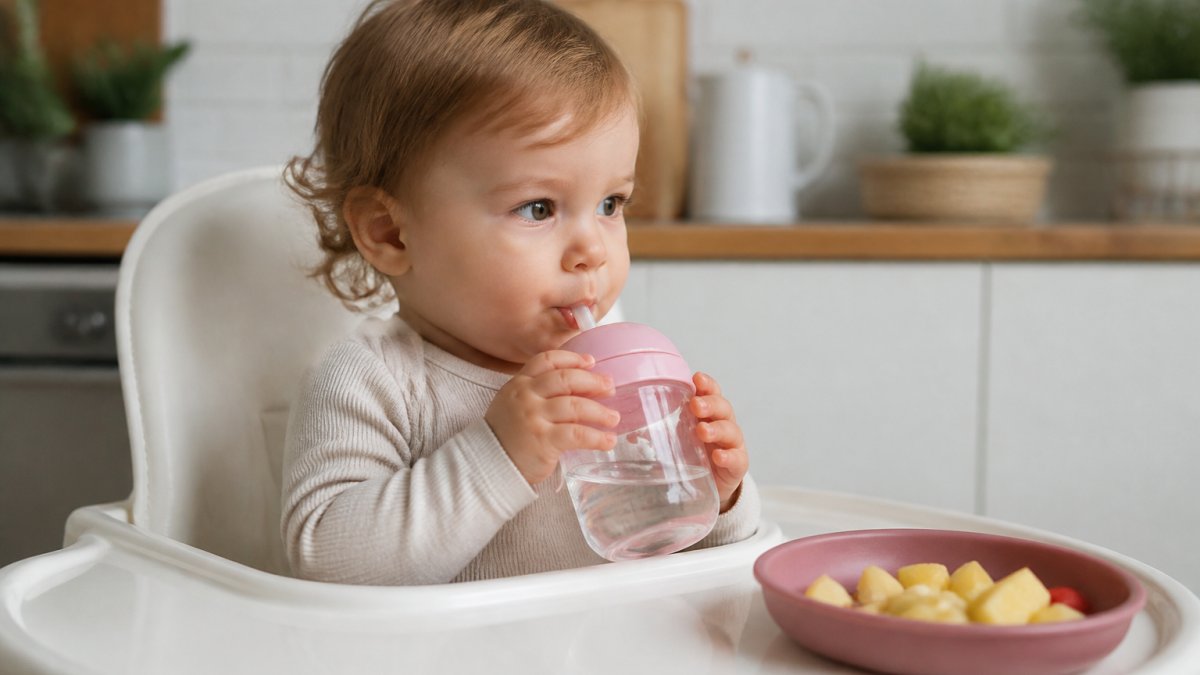
Many babies can start learning straw cups between 6 and 9 months, often before they master a sippy cup. Six months is the common starting point, when most babies sit with support, show interest in food, and bring objects to their mouth. Premature babies often need adjusted timing, so talk to your pediatrician if unsure.
- Straw drinking is not a reflex; it requires coordinated oral motor skills that build on each other.
- Sipping through a straw works the same muscles a baby uses to form sounds later.
- Start with a straw that flows freely and skip valve-heavy cups at first.
- End a practice session after three successful sips, even if your baby wants more.
- For a baby under 12 months, food-grade silicone is the default straw material.
Table of Contents
- When Can Babies Use Straw Cups? Signs of Developmental Readiness
- Benefits of Straw Cups for Speech Development and Oral Motor Skills
- How to Teach Baby to Drink from a Straw in 5 Steps
- Best Straw Cups for 6 Month Old Beginners
- Straw Cups vs. Sippy Cups: Why Pediatric Dentists Prefer Straws
- Material Safety, Cleaning, and Baby-Led Weaning Integration
- Choosing the Right Straw Cup for Your Baby
- Frequently Asked Questions
When Can Babies Use Straw Cups? Signs of Developmental Readiness
Many babies can start learning straw cups between 6 and 9 months, often before they master a sippy cup.
Straw cups are lidded cups with a drinking tube your baby sips from. They build the same muscles used for speech.
The Typical Window: 6 to 9 Months
Six months is the common starting point, when most babies sit with support, show interest in food, and bring objects to their mouth.
Not every baby hits this at exactly six months; premature babies often need adjusted timing. Talk to your pediatrician if unsure.
Oral Motor Skills That Point to Readiness
Straw drinking is not a reflex. It takes a coordinated set of skills that build on each other.
Oral motor skills are the movements of the lips, tongue, jaw, and cheeks used for eating, drinking, and speaking. Straw drinking pulls several together at once.
That last point matters. A tongue thrust pushes liquid forward instead of back, making straw drinking harder.
Benefits of Straw Cups for Speech Development and Oral Motor Skills
A straw is a workout for the mouth. The benefits of straw cups for speech development come down to muscle strength and control.
Sipping through a straw works the lips, tongue, jaw, and cheeks together, the same muscles a baby uses to form sounds later.
A speech-language pathologist will often recommend straw drinking as a simple daily exercise that builds sucking and swallowing coordination without special equipment.
How to Teach Baby to Drink from a Straw in 5 Steps
The fastest way to teach a baby to drink from a straw is short, low-pressure practice with a straw that lets liquid flow easily. Skip the valve-heavy cups at first. They make babies work too hard and quit.
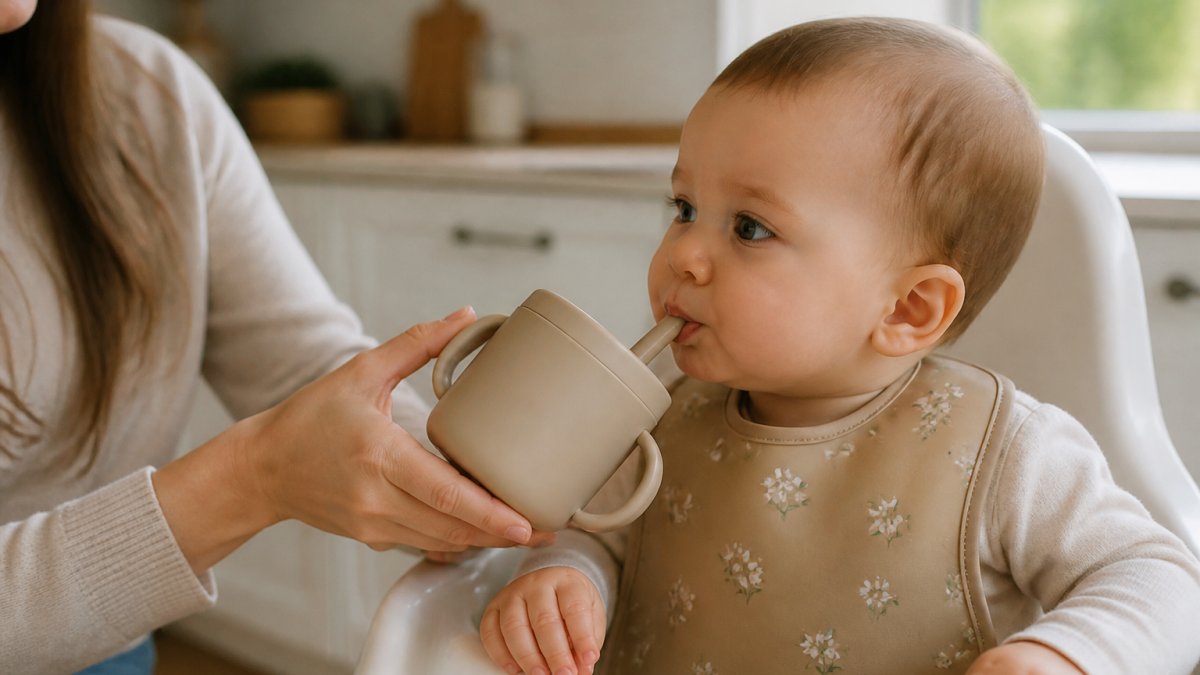
- Start with a straw that flows freely. A silicone straw in a soft cup works well. You want liquid to move when your baby sips, not fight back.
- Dip the straw in liquid and cap the top with your finger. Place the other end near your baby's lips. Release your finger so a drop lands on their tongue.
- Let them taste and repeat. Do this a few times. Your baby learns that sucking brings liquid.
- Move to the cup. Hold the cup steady at a slight tilt. Let your baby lean in and sip.
- Practice daily for a few minutes. Short, happy sessions beat long, frustrating ones.
For a deeper walkthrough with more practice ideas, see our guide on how to teach your baby to use a straw cup.
Troubleshooting Refusal and Gagging: A Sensory-Based Approach
Refusal and gagging are usually not stubbornness, they are a mismatch between the straw's mechanics and what your baby's mouth can organize. A speech-language pathologist looks at three systems: the suck-swallow-breathe sequence, tactile tolerance inside the mouth, and postural stability.
Why a baby gags on the first sip. Gagging is a protective reflex triggered when liquid hits the back of the tongue or soft palate before the swallow is ready, not choking. A common pattern is a straw delivering too much volume per sip: a wide-bore straw or heavy valve that releases a surge once the seal breaks. The fix is mechanical, not motivational:
- Narrow the straw. A slimmer straw delivers a smaller bolus per sip, giving the swallow time to organize. This is the single most effective change for a gagging baby.
- Shorten the straw. A straw that reaches only the front of the mouth lets the baby practice lip seal without triggering a deep-tongue reflex.
- Lower the cup. Hold the cup so the straw's tip sits near the front of the lips, not angled toward the back of the throat. Gravity does the rest.
Why a baby refuses the straw. Refusal usually falls into one of four sensory profiles. Match the strategy to the profile:
- Tactile-defensive: the baby rejects the straw touching the lips or tongue. Let the baby mouth a soft silicone straw as a teether for a few days, then dip it in breast milk or formula and touch it to the lower lip only. Progress to the tongue, then to a sip.
- Over-responsive to flow: the baby startles at the first drop. Use the finger-cap method (step 2 above) so the baby controls the release, and practice with an empty straw first so the sensation is predictable.
- Under-responsive / low arousal: the baby shows no interest. Add a flavor the baby already knows (breast milk, formula, or a liked puree) and pair the cup with a familiar mealtime routine.
Chewing the straw. Chewing often signals the baby is seeking proprioceptive input through the jaw, not rejecting the cup. Offer a firm teether (or firmer straw) five minutes before practice so the jaw is regulated, then switch to the drinking straw.
Watch Out
If gagging is frequent and comes with coughing, choking, breathing changes, or a wet or gurgly voice after drinking, stop and talk to your pediatrician or a feeding therapist. Those are signs of aspiration risk, not a practice problem, and should not be pushed through.
Pro Tip
The 3-sip rule: end a practice session after three successful sips, even if the baby wants more. Short wins build the association that the straw is easy, which is what carries over to the next session.
Best Straw Cups for 6 Month Old Beginners
The best straw cups for a 6 month old have a soft straw, easy flow, and a design small hands can grip. We favor valve-free or lightly valved options for beginners.
Our top pick is the Baby Feeding Straw Cup Silicone Sippy Leak-Proof Bottle. It is 100% food-grade silicone, dishwasher-safe, and works as a straw cup, sippy cup, or open cup.
Baby Feeding Straw Cup Silicone Sippy Leak-Proof Bottle →

For a second option to compare, look at the Baby Feeding Bottle Kid's Mug Silicone Straw. It is a simple single-layer design in soft colors.

| Cup | Material | Best For | Price |
|---|---|---|---|
| Silicone Sippy Leak-Proof Bottle | Food-grade silicone | Beginners, spill-prone homes | $17.56 |
| Kid's Mug Silicone Straw | Bone china | Older babies, small sips | $8.51 |
Straw Cups vs. Sippy Cups: Why Pediatric Dentists Prefer Straws
Straw cups win for most babies, and pediatric dentists generally agree. A sippy cup keeps liquid pooling around the front teeth, and long-term use can affect how teeth sit.
Pediatric dentists commonly suggest moving away from prolonged sippy cup use as your child grows.
The sippy cup transition does not have to be all or nothing. Many parents use both for a few weeks.
Material Safety, Cleaning, and Baby-Led Weaning Integration
Material safety is an important part of choosing a straw cup. Look for cups labeled BPA-free, phthalate-free, and lead-free. Food-grade silicone and stainless steel are safe bets.
The Baby Feeding Straw Cup Silicone Sippy Leak-Proof Bottle is made of 100% food-grade silicone and is listed as free of BPA, BPS, PVC, latex, phthalates, lead, cadmium, and formaldehyde.
Silicone vs. Plastic vs. Stainless Steel: What the Trade-Offs Actually Are
No straw material wins on every axis. The right choice depends on your baby's stage and your household. Here is the honest comparison most buying guides skip:
Food-grade silicone
- Best for: beginners, teething babies, and any baby who chews the straw.
- Why: soft enough to protect gums, flexible enough that a fall does not crack it, and it tolerates the dishwasher and boiling water.
- Trade-offs: silicone can hold onto flavors and odors, especially in milk; it also attracts lint and can develop a faint smell if not fully dried. Replace at the first sign of cloudiness, tackiness, or persistent smell, the surface has degraded and can harbor bacteria in micro-tears.
Plastic (polypropylene, Tritan, or similar)
- Best for: older babies and toddlers who have stopped chewing and need a rigid straw that will not collapse.
- Why: rigid, cheap, and widely available. Tritan is a common BPA-free copolyester used in many toddler cups.
- Trade-offs: rigid plastic can crack or splinter at the tip, a mouth-injury risk for a chewer. Plastic also scratches, and scratched plastic is harder to sanitize. Avoid any plastic straw not explicitly labeled BPA-free and phthalate-free, and retire it at the first crack or deep scratch.
Stainless steel
- Best for: toddlers past the chewing stage and families who want a straw that will not degrade.
- Why: does not hold flavors, does not scratch in a way that harbors bacteria, and is fully recyclable.
- Trade-offs: rigid metal is a real injury risk if a baby falls while the straw is in the mouth, so most feeding therapists do not recommend bare stainless straws for babies under about 12 months or for any baby who chews. If you use one, pair it with a silicone tip.
Key Takeaway
For a baby under 12 months, food-grade silicone is the default: it is the only common straw material that is soft enough to be safe for a chewer and heat-stable enough to sanitize fully. Move to rigid plastic or stainless only after the chewing phase ends.
Cleaning: The Steps That Actually Matter
Cleaning matters as much as material, and the failure point is almost always the inside of the straw, not the cup.
- Disassemble the lid and straw every time, a straw left attached traps moisture and milk residue at the joint.
- Use a cleaning brush made for straws; a bottle brush alone will not reach the bore.
- Wash in warm soapy water or the dishwasher. Check manufacturer instructions: most silicone and Tritan cups are top-rack dishwasher safe, but some valves and weighted straws are hand-wash only.
Baby-Led Weaning Integration
If you are doing baby-led weaning, straw cups fit right in. Offer the cup alongside soft finger foods at meals. Your baby practices self-feeding and independent drinking at the same time.
The BLW-specific timing point most guides miss: introduce the straw cup at the same meal as the first finger foods, not before. BLW babies are already learning to bring food to the mouth and manage texture, and the straw cup rides on that same oral-motor practice.
Choosing the Right Straw Cup for Your Baby
Match the cup to your baby's stage, not the other way around. A 6 month old needs a soft straw and easy flow. A 12 month old may be ready for a firmer straw and more capacity.
- Soft silicone straw that protects gums
- Valve-free or easy-flow design for beginners
- Handles sized for small hands
Also think about posture. A baby who sits upright with steady fine motor control will have an easier time than one slouched in a high chair.
Frequently Asked Questions
Can a 6-month-old drink from an open cup?
Some 6-month-olds can take small sips from an open cup with an adult holding it, but most need practice with lip seal and jaw stability first. Open cups build oral motor skills, yet they spill easily. Many parents start with a straw cup or a cup that converts between straw and open-cup use, then introduce a small open cup at meals once sitting balance improves. Always supervise and offer only a few ounces at a time.
Are straw cups better than sippy cups for oral development?
Pediatric dentists and speech-language pathologists often favor straw cups because drinking through a straw uses lip seal, tongue retraction, and jaw stability, which support speech development. Traditional hard-spout sippy cups can encourage a tongue thrust pattern if used for long periods. A valve-free straw cup also lets babies control their own flow, which builds independent drinking skills and makes the bottle-to-cup transition smoother.
How do I teach my baby to drink from a straw if they keep refusing?
Try a valve-free straw so liquid moves with minimal suction. Dip the straw tip in breast milk, formula, or a puree so your baby tastes it, then place the straw in the cup and let them explore. Use the straw-in-a-cup trick: seal the top with your finger to trap liquid, release it into your baby's mouth, then hand over the cup. Offer it during calm, alert times and expect several weeks of practice before it clicks.
What should I look for in the best straw cups for a 6 month old?
Look for a valve-free or easy-suck straw, a soft silicone tip that protects gums, double handles sized for tiny hands, and a spill-proof lid for carpets and beds. Check that the cup is free of BPA, BPS, PVC, phthalates, and lead, and that it disassembles fully for cleaning. A convertible design that works as a straw cup, sippy cup, and open cup gives you more use as skills grow.
Starting solids and cup skills at the same time can feel overwhelming. That is exactly why we curate our feeding gear with safety and simplicity in mind. Our silicone straw cup gives you a leak-proof, dishwasher-safe option your baby can grow with, and our team is here to help you pick what fits your stage. Get started with Best Baby Care Outlet and give your little one a confident first sip.


